


 English
 中文简体
中文简体 عربى
عربى
Content
Not all PVC panels are built the same. A 9mm foam-core interior panel and a 17mm co-extruded ASA/PVC fencing board both carry the "PVC" label — yet their load-bearing performance differs by an order of magnitude. If you are specifying panels for a project where impact resistance or outdoor durability matters, the type and density of the panel are the two numbers that actually predict strength.
The Three Structural Categories of PVC Panels
PVC panels fall into three broad structural groups, each with a very different strength profile.
Foam-core PVC uses a blowing agent during extrusion to create a lightweight cellular interior sandwiched between thin solid skins. Density drops to roughly 0.5–0.7 g/cm³. The panel is easy to cut, quick to install, and cost-effective for indoor ceilings, bathroom cladding, or display boards — applications where loads are minimal.
Rigid (solid) PVC is a homogeneous material extruded without air inclusions. Density sits closer to 1.3–1.5 g/cm³, giving it noticeably higher tensile strength and impact resistance. It holds screws firmly, resists denting under mechanical stress, and does not deform under sustained compressive loads the way foam-core panels can.
Co-extruded ASA/PVC panels add an Acrylonitrile Styrene Acrylate (ASA) cap layer over a rigid PVC core. The PVC layer provides structural density; the ASA layer absorbs UV radiation and weathering that would otherwise degrade the surface. For outdoor use, this dual-layer construction is where raw strength meets long-term colour and surface retention.
What "Strong" Actually Means in a Panel Context
Strength in wall and cladding panels is not a single number — it breaks into four measurable properties that matter at different moments in a panel's life.
| Property | Foam-Core PVC | Rigid Solid PVC | ASA/PVC Co-extruded |
|---|---|---|---|
| Impact resistance | Low–Medium | High | High |
| Flexural (bending) strength | Low | Medium–High | High |
| Screw-holding capacity | Poor | Good | Good |
| UV / surface durability | Poor | Medium | Excellent |
For indoor-only decorative work, foam-core panels are adequate. For anything structural, external, or in high-traffic zones, rigid or co-extruded panels are the only defensible choice.
Why Thickness Alone Does Not Equal Strength
A 25mm foam-core panel is not stronger than a 17mm co-extruded solid board. Thickness adds rigidity in bending, but the core density determines how the panel responds to point impact and fastener loads. Thin-walled foam panels can reach a tipping point where the outer skin punctures and the aerated core deforms permanently — no amount of extra thickness fixes a low-density core under real-world conditions.
The right question is not "how thick is the panel?" but "what is the core structure and density at that thickness?" A 17mm co-extruded high-strength board certified to FSC, CE, and ISO 9001 standards will consistently outperform a thicker foam alternative in tensile tests, flexural tests, and falling-mass impact tests — because the underlying material is fundamentally denser and more uniform.
Outdoor vs Indoor: Where the Strength Gap Becomes Critical
Indoors, strength demands are relatively forgiving. A bathroom ceiling panel holds its own weight and little else. Outdoor applications are a different environment entirely: UV exposure, thermal cycling between cold nights and hot afternoons, rain, and direct physical contact (foot traffic on decking, wind load on fencing, hail impact on cladding) all stress the panel repeatedly over years.
Standard PVC without an ASA surface layer begins to chalk and embrittle under UV exposure, losing impact resistance as the polymer degrades. Co-extruded ASA/PVC panels are engineered to hold structural and surface integrity across that entire exposure cycle. For UV-resistant exterior wall cladding for harsh climates, the ASA cap layer is not optional — it is what keeps the structural core protected long-term.
Swimming pool surrounds, commercial facades, and garden fencing present the same logic. A high-strength ASA/PVC co-extruded fencing board rated for moisture, fire, and impact at 156mm width and 17mm thickness gives you the density of rigid PVC and the weather resilience of ASA in a single panel. That combination is what most outdoor projects actually need.
Application Match: Choosing the Right Panel by Scenario
- Interior walls and ceilings (low-load): Foam-core PVC or rigid PVC panels at 8–9mm. Lightweight, quick to install, sufficient for decorative purposes.
- Bathroom and wet-area cladding: Rigid PVC or ASA/PVC panels. Moisture resistance is non-negotiable; foam-core panels with open pores in cut edges can absorb water over time.
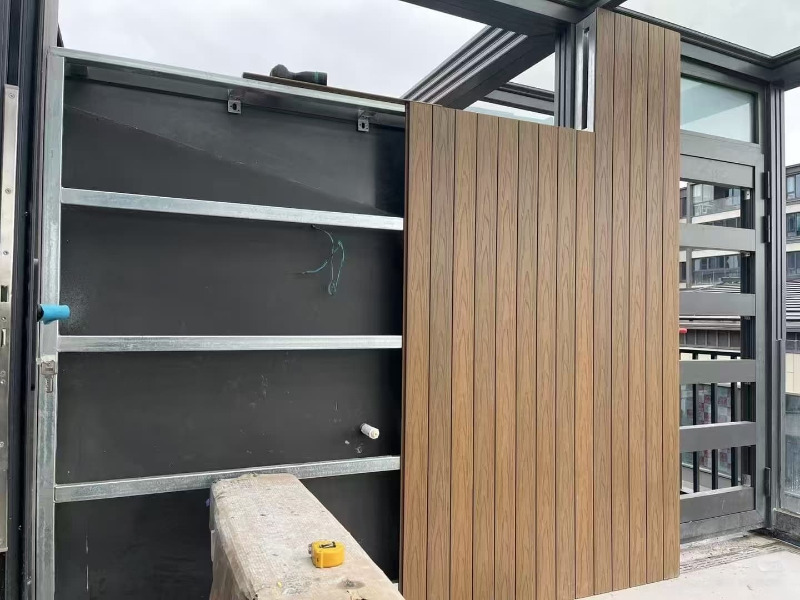
- Exterior wall cladding and siding: Co-extruded ASA/PVC panels. UV stability and flexural strength are both required. Look for panels with CE and ISO 9001 certification and a minimum 16mm thickness for residential siding; 20–25mm for commercial facades.
- Outdoor decking: Co-extruded ASA/PVC decking boards at 24mm thickness or above. The non-slip surface and corrosion resistance make these the practical alternative to timber or composite decking without the maintenance overhead.
- Fencing: High-density co-extruded boards at 17mm+ with fire-retardant and anti-static ratings for commercial or institutional perimeter fencing.
For projects spanning multiple zones — say, an outdoor commercial space that combines facade cladding with decking and decorative grille screens — a comprehensive outdoor wall panel system using matched ASA/PVC profiles gives you consistent performance across every surface rather than mismatched products from different material categories.
Certifications as a Strength Proxy
When you cannot run your own flexural or impact tests, certifications are the next-best indicator of genuine structural performance. Look for CE marking (confirming compliance with European construction product standards), ISO 9001 (production quality management), FSC (for responsible sourcing), and SGS or Intertek test reports that include falling-mass impact resistance, tensile strength, and dimensional stability after heat exposure. Any panel sold purely on price without third-party test documentation is a risk in structural or outdoor applications.
The Short Answer
For indoor decorative use, foam-core PVC is fine. For any outdoor or load-bearing application, co-extruded ASA/PVC panels with a rigid solid core are the strongest and most durable option. Thickness matters, but core density and surface layer composition are the decisive factors. Match the panel type to the structural demand of your project — not just the budget — and the choice becomes straightforward.
If you are sourcing panels for an outdoor project and need confirmed performance data, explore the full outdoor co-extruded PVC/ASA panel range with certified impact and flexural test results to find the right specification for your application.


