


 English
 中文简体
中文简体 عربى
عربى
Content
The Short Answer: Boiling Water Won't Melt PVC — But It Can Damage It
Boiling water sits at 100°C (212°F). Standard rigid PVC begins to melt only between 160°C and 210°C (320°F–410°F). So no, a pot of boiling water will not turn PVC into liquid. But that does not mean PVC is safe around hot water or high ambient temperatures — and this distinction matters a great deal for anyone specifying building materials.
PVC is an amorphous thermoplastic. Rather than snapping from solid to liquid at one precise point, it passes through a softening zone first. Understanding that zone is where things get practical.
Three Temperature Zones Every Buyer Should Know
PVC behavior under heat follows three recognizable stages:
| Temperature Range | What Happens to PVC | Risk Level |
|---|---|---|
| 60–87°C (140–189°F) | Glass transition — material shifts from rigid to rubbery; begins to lose structural stiffness | Caution under load |
| 100–140°C (212–284°F) | Significant softening; pressure-rated pipe loses most of its load capacity; panels can warp or bow | High risk of deformation |
| 160–210°C (320–410°F) | True melt range for processing; PVC flows and can be extruded or molded | Full structural failure |
The takeaway: boiling water at 100°C sits right inside the danger zone for rigid PVC under load. A pipe carrying water under pressure at that temperature will not hold. A wall panel installed on a south-facing facade in a hot climate may see surface temperatures exceeding 70–80°C on dark-colored surfaces — enough to push the material past its glass transition and cause visible bowing.
Why Standard PVC Struggles in Hot Climates
Heat from direct sunlight is a different problem from hot water, but the physics is the same. On a 40°C day in the Middle East or Southeast Asia, a dark-colored standard PVC panel absorbs solar radiation and can reach surface temperatures of 70–85°C — well above the glass transition point. The result is gradual distortion, color fading, and surface chalking over time.
The root issue is UV degradation combined with thermal stress. Standard PVC does not contain inherent UV stabilizers. Without them, UV radiation breaks down the polymer chains, accelerating both color change and heat sensitivity. A panel that handles 70°C in year one may start deforming at 60°C by year three.
This is why the outdoor building industry has largely moved toward co-extruded ASA/PVC composite structures for facade, decking, and wall cladding applications.
How ASA/PVC Co-Extruded Panels Solve the Heat Problem
ASA (Acrylonitrile Styrene Acrylate) is co-extruded as an outer cap layer over a rigid PVC core. ASA has significantly better UV resistance and thermal stability than standard PVC, which addresses both failure modes at once.
The ASA cap reflects more solar radiation than bare PVC, keeping the panel surface cooler. It also resists the UV-induced chain scission that causes conventional PVC to lose its heat tolerance over time. The PVC core provides structural rigidity and dimensional stability. Together, the two layers maintain performance in climates where standard PVC would fail within a few years.
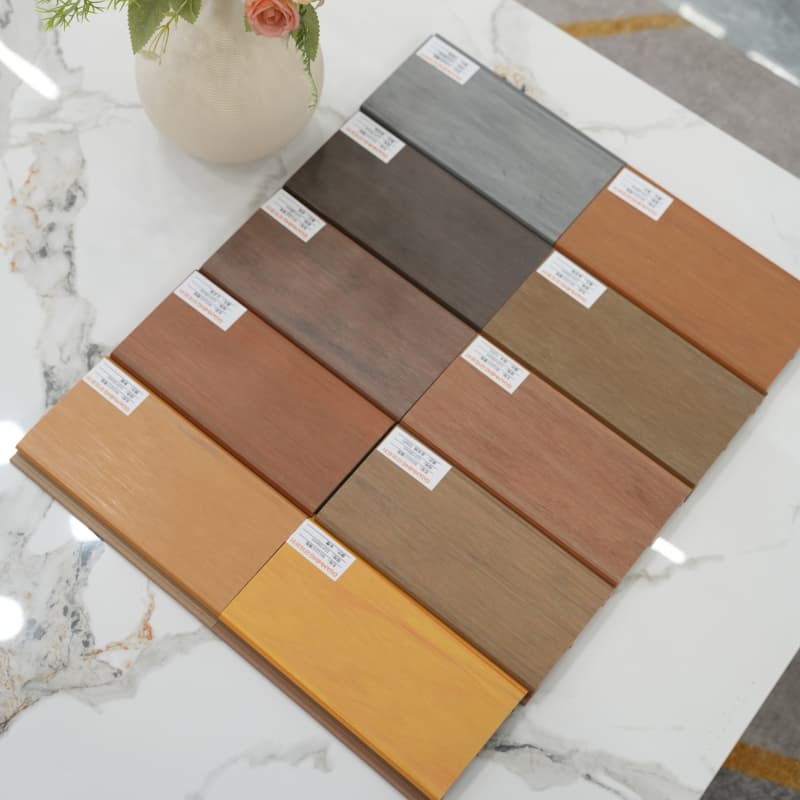
For reference, Guanmingdeco's UV resistant ASA/PVC exterior siding panels for hot climates are built with a PVC core and ASA cladding layer, with a panel weight of 650–680 g/m and dimensions of 112 mm × 16 mm. They carry FSC, CE, ISO 9001, SGS, and Intertek certifications and have been independently tested for dimensional stability after heat exposure — a test specifically designed to evaluate whether a panel maintains its shape under sustained thermal load.
These panels are used across more than 20 countries, with strong deployment in the Middle East, Southeast Asia, and South America — precisely the hot-climate markets where standard PVC most often fails.
Practical Guidelines: Choosing the Right PVC Product for the Temperature
Not all PVC products are the same, and the right choice depends on the application:
- Cold and temperate climates, indoor use: Standard rigid PVC panels perform reliably. Surface temperatures stay well below the glass transition zone.
- Hot climates, outdoor wall cladding or decking: Specify ASA/PVC co-extruded products. The ASA cap handles UV and limits solar heat absorption; the PVC core maintains structural integrity.
- Hot water piping: Neither standard PVC nor ASA/PVC panels are designed for this. CPVC (Chlorinated PVC), with a melt range of 230–260°C, is the appropriate choice for systems operating above 60°C.
- Dark-colored panels in high-sun environments: Choose lighter colors where possible. Dark surfaces absorb more radiation and can reach surface temperatures 20–30°C above ambient air temperature.
If you are sourcing panels for a hot-climate project, reviewing the heat exposure test data — specifically dimensional stability after heat exposure and the linear thermal expansion coefficient — is the most reliable way to compare products. Guanmingdeco publishes Intertek test reports for their outdoor co-extruded ASA/PVC exterior siding panel series, covering exactly these parameters.
Summary
Water needs to be between 160°C and 210°C to actually melt standard PVC — far beyond what any water system or outdoor environment delivers. The real risk is far lower: at 60–87°C, PVC softens, and sustained exposure at those temperatures causes warping, bowing, and long-term degradation, especially in direct sunlight. For outdoor applications in hot climates, ASA/PVC co-extruded panels are the practical answer — they maintain shape, color, and structural integrity under conditions that quickly degrade standard PVC products.
If you are evaluating materials for a hot-climate facade or decking project, check out the detailed comparison of standard PVC vs ASA/PVC in hot weather conditions for a deeper technical breakdown.


